A west-facing living room in Dubai can feel noticeably hotter than the rest of the home long before the air conditioning has a chance to catch up. The same problem shows up as a burning steering wheel, glare across an office monitor, or a yacht cabin that becomes difficult to enjoy at midday. The best heat control options are not automatically the darkest glass treatment or the highest-priced film. They are the options that address the specific source of discomfort while preserving the light, visibility, appearance, and glass safety you need.
For UAE properties and vehicles, that distinction matters. Strong sunlight brings visible light, ultraviolet radiation, and solar energy that can pass through glass as heat. A useful recommendation starts with where the glass faces, how it is used, whether privacy or glare is part of the problem, and what the glass can safely accept.
Best Heat Control Options: Start With the Actual Problem
Heat complaints often sound simple, but they can have different causes. If a room feels hot only in the afternoon, direct solar exposure through a particular elevation may be the main issue. If the temperature is manageable but screens are hard to read, glare control may matter more than maximum heat rejection. If furnishings are fading near large windows, UV protection becomes a priority alongside comfort.
For vehicles, drivers often want a cooler cabin without making night driving or parking visibility unnecessarily difficult. For offices, the goal may be reducing glare and hot spots while keeping a bright, professional interior. On yachts, the glazing, marine environment, curved panels, and access conditions all need to be assessed before a film is selected.
This is why a one-size-fits-all percentage or a generic promise of “heat proof” glass is not a reliable basis for choosing. The right option depends on the whole balance.
Ceramic Window Film for Vehicles
Ceramic automotive tint is usually the strongest all-around choice for vehicle owners who want meaningful solar control without relying solely on a very dark appearance. Quality ceramic films are designed to reject a substantial portion of infrared energy while also reducing glare and blocking UV exposure. They can remain comparatively clear, which is useful for drivers who value visibility and a factory-like finish.
The practical trade-off is cost. Ceramic film generally costs more than basic dyed tint, but it is typically the more appropriate choice when cabin heat is the real concern rather than appearance alone. It also avoids the signal-interference concerns associated with some metallic constructions.
At Dr SunShield, ceramic automotive options are structured in clear tiers: DS-ONE, DS-PRO, and DS-MAX. The difference is not simply a label. Higher tiers provide increasing infrared heat rejection and longer warranty coverage, with three, six, and ten-year warranties respectively. A driver who parks outdoors daily in Dubai may see value in a higher tier, while a lightly used second vehicle may not require the most premium specification.
Any automotive recommendation should also account for local tint regulations, the intended glass areas, and safe visibility. A film can reduce heat effectively without being selected purely for darkness.
Solar-Control Film for Homes, Villas, and Offices
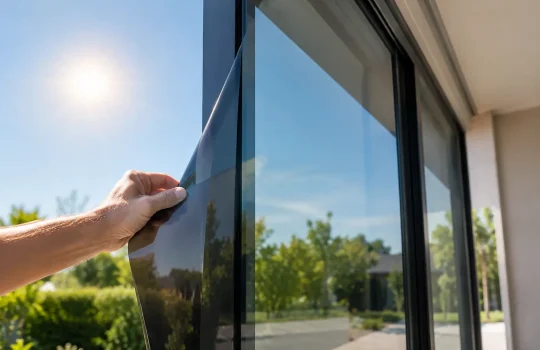
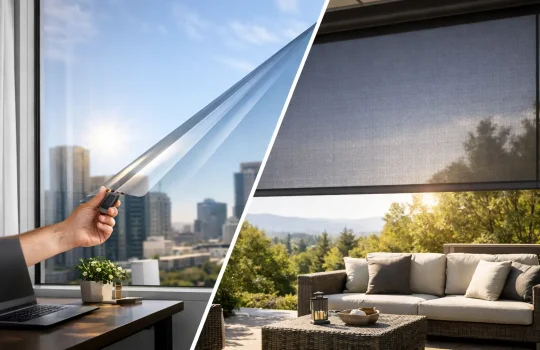
For existing glass in homes and commercial spaces, professionally installed solar-control window film is often the most practical heat-control upgrade. Replacing windows can be disruptive and expensive, particularly in occupied villas, offices, or leased premises. Film applies to the interior surface of suitable glass and can reduce solar heat, glare, and UV exposure without changing the window system itself.
The available looks range from subtle, low-reflective finishes to more reflective options that increase daytime privacy. A nearly clear film may be best when preserving the view and natural daylight is the priority. A more reflective film can make sense for a heavily exposed office facade or a villa with close neighboring properties, but it will change the exterior appearance and may create a more mirrored look in certain light.
Clearer Films for Heat Without a Dark Room
Many homeowners assume heat control means making a room visibly dark. That is not always necessary. Modern ceramic and spectrally selective films can target solar energy while retaining a lighter appearance than traditional dark tints. This makes them well suited to living rooms, kitchens, stairwells, and offices where daylight is valuable.
There is still a trade-off. A lighter film may not deliver the same glare reduction or daytime privacy as a darker or more reflective product. On a large west-facing wall of glass, the best answer may be a lighter heat-control film paired with curtains, blinds, or exterior shading for the most demanding afternoon period.
Reflective Films for Exposure and Daytime Privacy
Reflective solar film can be effective on highly exposed glazing, especially when occupants want stronger glare control and more daytime privacy. It is commonly considered for offices in Business Bay, DIFC, Dubai Marina, and similar locations where broad glass facades receive intense sun.
However, privacy from reflective film is generally dependent on lighting conditions. During the day, when it is brighter outside, the reflective side can reduce inward visibility. At night, with interior lights on, that effect can reverse. Customers seeking dependable privacy after dark should consider curtains, blinds, or switchable Smart Film rather than assuming a reflective film will solve every privacy scenario.
Smart Film When Privacy Changes by the Minute
Switchable Smart Film serves a different purpose from conventional solar-control film. At the press of a switch, compatible glass can change between a clear and private frosted state. It is particularly useful for meeting rooms, clinic spaces, bathroom glazing, internal partitions, and homes where privacy needs change throughout the day.
Smart Film should not be chosen as a substitute for a dedicated high-performance solar film when heat rejection is the primary requirement. It can be part of a broader glass strategy, but its main value is on-demand privacy. Electrical access, wiring routes, edge detailing, and glass condition need to be considered before installation.
Exterior Shading and Window Treatments
Where solar gain is extreme, stopping sunlight before it reaches the glass can be very effective. Awnings, pergolas, louvers, exterior blinds, and landscaping can all reduce direct exposure. These approaches can work especially well on villa terraces, garden-facing rooms, and windows with a predictable afternoon sun angle.
Their limitations are practical rather than technical. Exterior systems require space, maintenance, approvals in some communities, and a design that suits the property. Interior curtains and blinds offer flexible privacy and light control, but because the sun has already passed through the glass, they are generally less effective at reducing solar heat than exterior shading or solar-control film.
Often, the strongest result comes from combining solutions. Film provides everyday heat and UV control, while blinds or curtains manage low-angle sun and nighttime privacy.
Safety Film Is Not the Same as Heat Film
Safety and explosion-protection films are designed to help retain broken glass fragments after impact or breakage. They can be a sensible option for properties where glass safety is a defined concern. They should not be presented as a primary heat-control product unless the selected construction also includes solar-control properties.
This distinction is worth making because different films solve different risks. A clear safety film may preserve the appearance of glazing and improve fragment retention, while a solar-control film is selected for heat, glare, and UV. In some cases, a combined approach may be possible, but compatibility and installation method must be evaluated rather than assumed.
Why Glass Assessment Comes Before Film Selection
Not every piece of glass should receive every film. Glass type, pane size, existing damage, edge condition, insulated-glass construction, shading pattern, and how the panel is framed can affect suitability. Certain films can increase thermal stress on some glass types, particularly when applied to already stressed or partially shaded panels.
A proper assessment also considers access. High-level windows, fixed yacht glazing, occupied offices, and large villa facades each have different installation requirements. Careful cleaning and surface preparation are essential because dust, sealant residue, or contamination can affect the finished result.
Performance figures also need context. A solar meter demonstration can be useful for comparing how different samples transmit solar energy under the same test conditions. It does not predict the exact temperature of a particular room or vehicle, because insulation, air conditioning, window size, orientation, roof exposure, and occupant behavior all affect real-world comfort.
Choose the Option That Solves the Daily Frustration
If your main complaint is a hot car after parking outside, ceramic tint is usually the sensible starting point. If afternoon sun overwhelms a villa room or office, a solar-control film selected for that glass and orientation may provide the best improvement with minimal disruption. If privacy is the changing requirement, Smart Film or window treatments may be more appropriate. If broken-glass retention is the concern, safety film should lead the discussion.
The useful question is not, “What is the best film?” It is, “What do I need this glass to do better every day?” A clear answer to that question makes it far easier to select a solution that feels right long after installation.