A bathroom overlooking a neighboring villa, a glass-partitioned meeting room, and a street-facing reception all have the same basic problem: people need privacy without turning a bright space into a dark one. When comparing privacy film versus etched glass, the better option depends less on which finish looks nicer in a sample and more on what the glass needs to do every day.
For UAE homes and commercial spaces, that decision can also involve strong sun, glare, cleaning demands, existing glazing, access for installation, and whether the privacy requirement may change later. Etched glass is a permanent architectural finish. Privacy film is an applied solution that can be tailored, replaced, or removed. Both can look refined when specified properly, but they solve different problems.
Privacy Film Versus Etched Glass: The Core Difference
Etched glass is glass whose surface has been permanently treated, usually through acid etching or sandblasting, to create a translucent appearance. It diffuses the view through the pane while still allowing light to pass. It is commonly chosen when privacy is part of the original interior design, such as a fixed bathroom window, a hotel-style shower screen, or permanent office partitions.
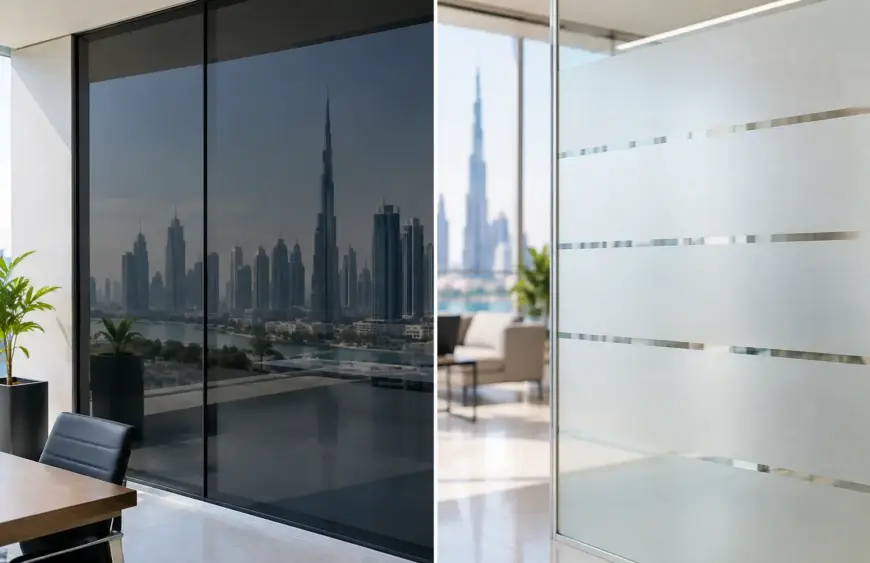
Privacy film creates a similar obscured-glass effect without replacing or treating the glass itself. Frosted, matte, patterned, gradient, and custom-cut films are applied to the existing pane, usually on the interior-facing surface. The result can be full coverage or selective coverage, such as a privacy band across the middle of an office partition while leaving the top of the glass clear.
That distinction matters. Etched glass commits the property to one look and one level of visibility. Film gives owners and tenants more flexibility. If a room changes use, a tenant moves out, or a design is refreshed, film can typically be removed and replaced without changing the glass.
When Etched Glass Is the Better Fit
Etched glass makes sense when the privacy requirement is permanent and the glass is being specified before fabrication or during a major renovation. It has an integrated appearance because the finish is part of the pane, not an added layer. For some high-end joinery, shower enclosures, and custom partition systems, that permanence is exactly the point.
It can also be practical where the glass is small, simple to replace, and being ordered new anyway. In that situation, the cost difference between a specialty glass finish and a separate film installation may be less significant than it would be for a completed villa or occupied office.
However, etched glass has trade-offs. Once installed, changing the degree of privacy generally means replacing the glass. The finish may also require more thoughtful cleaning than clear glass, especially if it is on an exposed surface that collects fingerprints, water spots, or construction residue. A textured or etched face should not be treated as maintenance-free simply because it hides some marks.
Etched glass also does not automatically address solar heat, UV exposure, or screen glare. It may soften visibility, but it is not a substitute for a purpose-selected solar-control film. If a west-facing room is uncomfortable by midafternoon, a frosted finish alone may not solve the problem.
Where Privacy Film Has a Practical Advantage
Privacy film is often the more efficient choice for existing glass. It avoids the disruption of removing panes, coordinating glazing fabrication, and managing a larger renovation scope. For an occupied office in Business Bay, a villa bathroom in Dubai Hills Estate, or a meeting room with clear internal partitions, film can deliver the visual privacy required with considerably less disruption.
The design control is another advantage. A full frosted film is suitable for spaces that need constant privacy. A gradient can obscure the lower portion of a window while preserving a clearer view above. Decorative patterns can define rooms, soften internal sightlines, or carry subtle branding on commercial glass. For offices, cut privacy bands can help maintain an open feel while reducing the exposed, fishbowl effect of clear partitions.
Film is also the more adaptable option for leased premises. Tenants often want privacy now but need the ability to return the glass to its original condition at the end of a lease, subject to the property agreement and the condition of the glass. A quality installation should be assessed around the glass type, existing damage, edge access, and the intended period of use rather than treated as a generic peel-and-stick product.
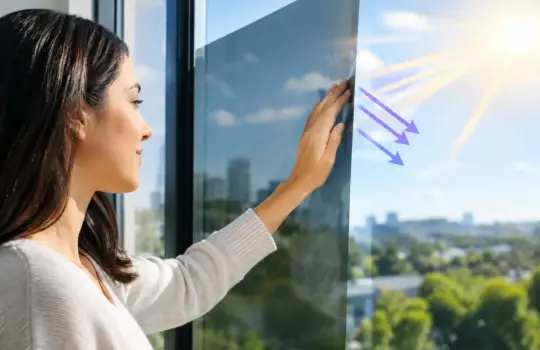
For customers who need privacy alongside heat and glare reduction, the conversation becomes more specific. Some solar-control films provide daytime visibility reduction while maintaining outward views, but they are not the same as frosted privacy film. At night, when interior lighting is brighter than outside, reflective or tinted films do not provide reliable privacy on their own. Curtains, blinds, frosted sections, or switchable Smart Film may be more appropriate depending on the room.
Light, Views, and the Privacy You Actually Need
A common mistake is assuming that any frosted surface provides privacy in every circumstance. It obscures detail, but silhouettes may still be visible when people stand close to the glass or when strong lighting is placed behind them. The required level of obscurity should be judged from the viewing distance and angle that matter in the actual space.
For a bathroom window facing another property, full frosted coverage may be appropriate. For an office meeting room, full coverage can make the room feel closed off and may remove useful daylight. A center band or gradient film may provide enough visual separation while preserving the connection between teams and the sense of space.
Natural light deserves the same attention. Both etched glass and frosted film diffuse light, which can reduce harsh direct views and create a softer interior appearance. Yet a heavily frosted finish can make a room feel less open, particularly on smaller windows or in corridors that depend on borrowed light. A sample held against glass is helpful, but it does not show the whole result. The surrounding wall colors, daylight direction, nighttime lighting, and sightlines all affect the finished look.
Heat Control Is a Separate Decision
In the UAE, privacy questions often arrive with a second complaint: the room is hot, glare makes screens difficult to use, or furnishings are exposed to intense sun. Privacy film and solar film can sometimes be combined in a solution, but they should not be confused.
A standard frosted film is selected mainly for appearance and obscurity. It may change the amount or quality of transmitted light, but it should not be sold as a high-performance heat-rejection product unless its specifications support that claim. Solar-control film is selected for measured optical and solar performance, with the suitable grade depending on the glass, orientation, desired appearance, and the balance between heat reduction and visible light.
For this reason, a proper assessment should start with the real priority. If the main concern is a direct view into a shower area, an opaque or frosted privacy treatment may be enough. If the room also receives harsh afternoon sun, the installer should examine whether a compatible solar-control approach, shading strategy, or a different glazing solution is needed.
Installation Quality Changes the Result
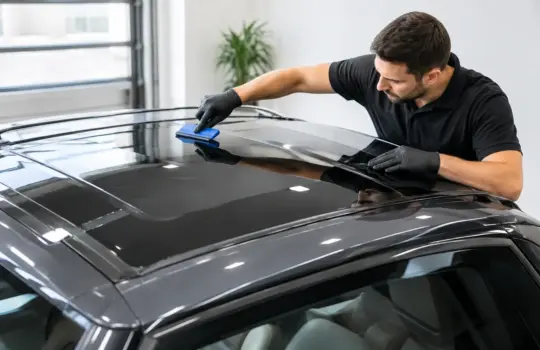
Privacy film is only as tidy as the preparation and installation behind it. Glass must be assessed for chips, scratches, failed seals, old adhesive, silicone near the edges, and access limitations. Dust control matters, particularly for large clear partitions where even small contamination can be visible after installation.
The installer should also confirm which side of the glass can be accessed and whether the proposed film is compatible with the glazing. This is particularly relevant for double-glazed units, specialty glass, marine glazing, and panes exposed to significant heat. Applying the wrong film to the wrong glass can create avoidable risk, so a recommendation should be based on the actual glazing rather than a photograph alone.
With etched glass, the critical work happens earlier in the design and glazing process. Confirm the orientation of the etched surface, the level of obscurity, cleaning expectations, edge detailing, and whether the finish will be exposed to moisture or frequent contact. A beautiful finish can become frustrating if it is installed on the wrong face of a shower screen or in a location where it is difficult to maintain.
Cost, Longevity, and Future Flexibility
Etched glass can be a long-term architectural choice, but replacing existing glazing to achieve that look can increase the overall project scope. Costs may include glass fabrication, removal, disposal, new glazing installation, access equipment, and potential adjustments to frames or seals. It can be worthwhile for a renovation with a fixed design vision, but it is rarely the simplest route for a finished property.
Privacy film usually has a lower-disruption path because the existing glass remains in place. Its lifespan depends on the film type, glass condition, exposure, cleaning practices, and installation quality. It is not permanent in the way etched glass is, but that is often an advantage rather than a compromise. A replaceable finish lets a property evolve without replacing a functioning pane of glass.
For high-privacy spaces where requirements change throughout the day, switchable Smart Film is worth considering. It can change from clear to opaque on demand, but it requires electrical planning and is not the right answer for every project. The added cost and technical coordination should be justified by a genuine need for controllable privacy.
A Better Way to Choose
Start by defining what people must not be able to see, from where, and at what times of day. Then consider whether the finish needs to be permanent, whether the room also has heat or glare issues, and how much daylight and visual openness should remain. Those answers are more useful than choosing between a frosted sample and an etched sample in isolation.
For completed villas, offices, and commercial spaces, privacy film is often the more practical recommendation because it preserves the existing glass and offers design flexibility. For newly fabricated glass in a permanent interior scheme, etched glass can be the right architectural decision. Dr SunShield approaches this by assessing the glazing, access, privacy goal, and any solar concerns before recommending a film rather than pushing a finish that does not solve the actual problem.
The best choice should feel intentional after installation: private where it needs to be, bright where it should be, and simple to live with long after the initial visual impact has worn off.