A villa overlooking a neighboring property, a street-facing office meeting room, and a yacht berth all have the same problem: glass brings in valuable light and views, but it can also leave people feeling exposed. Privacy glass is not one single product or outcome. It can mean a permanently obscured finish, a reflective solar-control film, a tinted window, or switchable Smart Film that changes from clear to private when powered.
The right choice depends on when privacy is needed, what must remain visible, how much heat and glare the glass receives, and whether the existing glazing can accept a film safely. For many UAE properties, the best answer is not the darkest possible glass. It is the option that solves visibility without making the space dim, hot, or disconnected from its surroundings.
What Privacy Glass Actually Does
Privacy solutions work in different ways. Some prevent people from seeing through glass at all times. Others limit visibility mainly during the day, when exterior light is stronger than interior light. A third category gives the user control, changing the glass from transparent to opaque on demand.
This distinction matters because daytime privacy and nighttime privacy are often confused. A reflective or dark solar film can make it difficult to see into a bright home or office during daylight hours. After dark, if indoor lights are on and it is darker outside, that effect can reverse. People outside may be able to see in unless curtains, blinds, or another permanent privacy treatment is used.
A good assessment starts with the direction of light, nearby sightlines, operating hours, and how the room is used. A ground-floor reception desk has different requirements from a bathroom window, an executive office, or a vehicle that needs a compliant level of tint.
The Main Privacy Glass Options
Frosted and decorative films
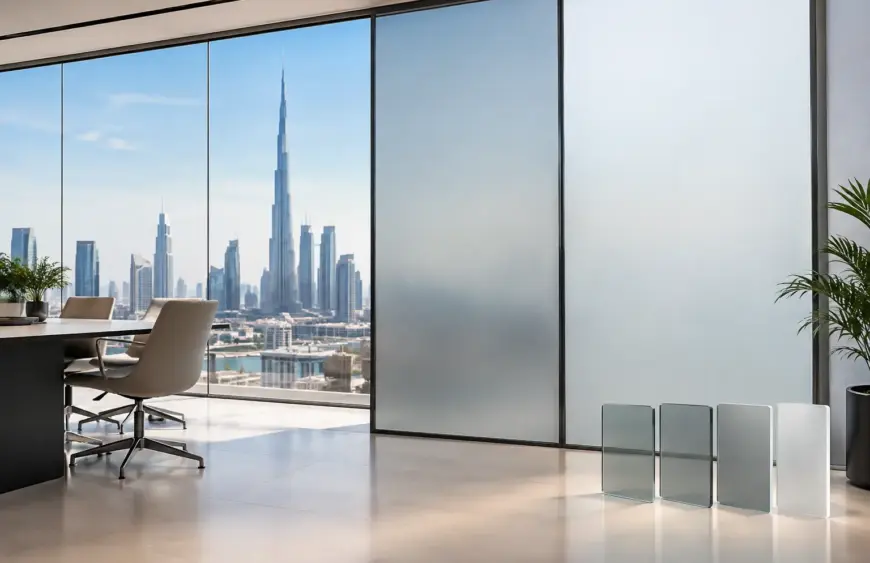
Frosted films diffuse light and obscure vision from both sides. They are a practical choice for bathroom windows, internal office partitions, clinic rooms, front-door sidelights, and lower sections of street-facing glazing. They allow daylight through while preventing a clear view, which is often more comfortable than closing blinds all day.
The trade-off is that frosted film also removes the view out. For that reason, it is commonly installed as a band, gradient, or carefully sized section rather than covering every pane. In an office, a waist-height privacy band can shield seated staff while keeping the room visually open. In a villa, frosting only the lower or side portion of a window may protect privacy without losing sky and garden views.
Decorative films can add patterns, lines, or branded designs. They should be planned around door hardware, glass joints, and cleaning access so the finished result looks intentional rather than applied as an afterthought.
Solar-control and reflective window films
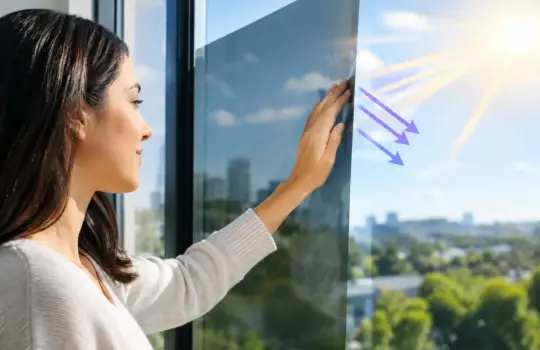
Solar-control film is often the better fit where privacy is only needed in daylight and the glass also suffers from heat or glare. Depending on the selected film, it can reduce solar energy, soften harsh brightness, block UV exposure, and create a more private exterior appearance while retaining a usable view from inside.
This approach is popular in sun-exposed villas, offices, retail spaces, and marine glazing. It can make rooms more comfortable near large windows and reduce screen glare in work areas. The visual result varies considerably by film type, glass color, installation side, and lighting conditions. A reflective film that looks subtle in one setting may look much darker or more mirrored on another elevation.
It is also not a substitute for full-time privacy. If a bedroom, meeting room, or bathroom needs protection regardless of the time of day, a frosted treatment, blind system, or switchable solution may be more appropriate.
Switchable Smart Film
Switchable Smart Film provides privacy when it is needed and clarity when it is not. When powered, the film is transparent. When switched off, it becomes opaque or frosted, obscuring the view through the glass while still allowing light to pass.
It is particularly useful for boardrooms, consultation rooms, luxury bathrooms, glass partitions, and areas where a permanent frosted finish would feel too restrictive. It can be operated by a switch and, depending on the design, integrated with controls or automation.
Smart Film needs more planning than standard window film. The glass condition, edge finishing, electrical route, transformer location, dimensions, and access for installation must all be assessed before work begins. It is a premium privacy solution, but it is not automatically the right choice for every window. Where a room only needs constant screening, a quality frosted film may deliver the better value and simpler installation.
Privacy tint for vehicles
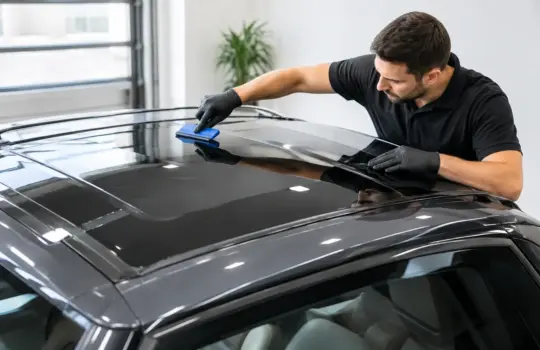
Automotive privacy is a separate conversation because heat rejection, visibility, appearance, and legal requirements all need to be considered together. Ceramic tint can reduce heat and glare without relying solely on a very dark look. That matters in the UAE, where a comfortable cabin can be a higher priority than maximum darkness.
The suitable shade and placement depend on the vehicle, the driver’s needs, and applicable regulations. A professional recommendation should explain the tint’s visible-light effect and heat-control performance rather than treating darker film as proof of better quality.
Why Glass Assessment Comes Before Film Selection
Not every glass panel should receive the same film. Existing glass type, pane size, edge condition, exposure to direct sun, whether the unit is single or double glazed, and any prior damage can affect compatibility. Some glazing systems, particularly certain insulated units or specialty glass, require more careful specification to avoid unnecessary thermal stress.
For marine projects, the assessment is equally specific. Yacht glazing may be curved, laminated, coated, or difficult to access. Salt exposure, window geometry, and the owner’s need for forward visibility all influence what can be installed and where.
This is why a quoted photo is helpful, but not always enough for a final recommendation. Measurements, glass details, access conditions, and the intended use of the room can change the answer. An installer who asks these questions is not making the process difficult. They are trying to avoid fitting a product that looks good initially but does not perform properly in its actual setting.
Balancing Privacy With Heat, Light, and Appearance
Most privacy decisions involve a trade-off. More permanent obscurity can mean less view. More reflectivity can improve daytime privacy but alter the exterior appearance. A darker film may reduce visible light, while a lighter ceramic solar-control film can offer strong heat performance with a more natural finish.
For homes, it is useful to consider the room by room experience. A family room may benefit from glare and heat reduction while keeping the view open. A bathroom may need complete obscurity. A home office could need a frosted band at eye level plus solar control to reduce screen glare.
Commercial properties often need a similar mix. Street-level meeting rooms may need decorative or frosted film for confidentiality. Perimeter offices can benefit from solar-control film where direct sun affects staff comfort and monitor visibility. Using one film across every elevation can be convenient, but it is not always the most considered solution.
When heat control is part of the objective, a live solar-meter demonstration can be useful for comparing how selected films transmit solar energy. It should be treated as a comparative tool, not a promise that every room will reach a precise temperature. Air conditioning capacity, window size, building orientation, shading, and air leakage all affect real-world comfort.
Questions to Settle Before You Choose Privacy Glass
Before approving a privacy treatment, establish whether privacy is needed all day or only in daylight, whether an outward view must remain clear, and whether heat or glare is part of the problem. Also consider how the glass will look from outside, particularly in communities or buildings with appearance guidelines.
Ask how the surface will be prepared, whether the glass and film combination is suitable, what warranty applies, and how to care for the finished installation. Quality installation depends on clean preparation, careful trimming, and allowing the film adequate time to cure. Minor moisture haze or small water pockets can be normal during the early curing period, depending on the film and conditions.
For larger villa, office, or yacht projects, a site review is often the sensible next step. It allows the installer to check access, confirm glass dimensions, identify electrical needs for Smart Film, and recommend where each treatment will make the biggest difference.
Dr SunShield approaches privacy as part of the wider glass-performance picture: discretion, heat, glare, UV exposure, natural light, and finish all need to work together. The most expensive option is not automatically the best one. The right result is the one that gives the space the privacy it needs without asking it to give up more light, comfort, or character than necessary.
A well-specified privacy solution should feel almost invisible in daily use. You notice it when the afternoon sun is less intrusive, when a meeting can happen without an audience, or when you can enjoy a bright room without feeling on display.